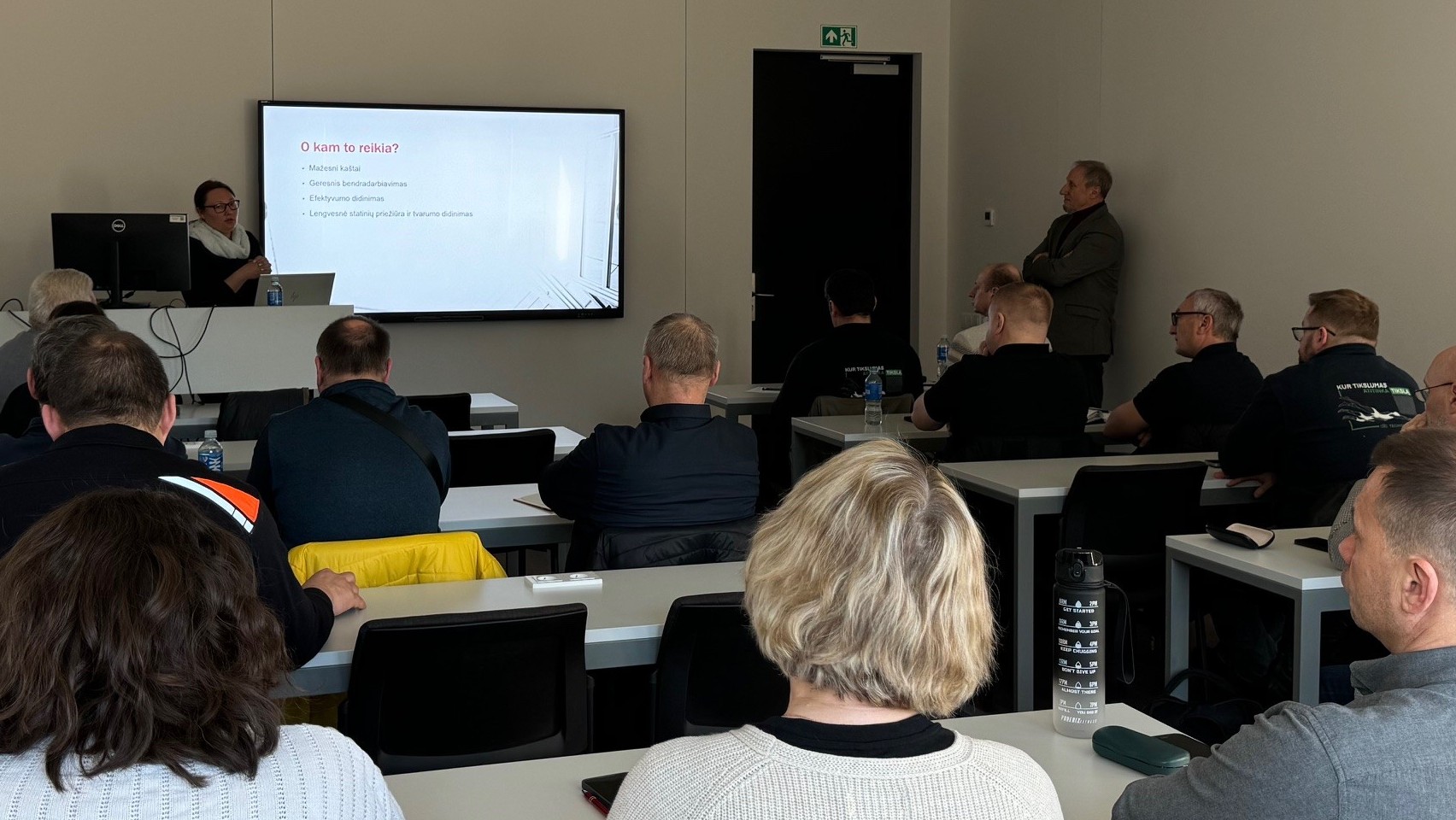
On April 21–22, 2026, PST Group BIM specialists Alvyda Anciūtė and Kęstutis Grimalis conducted a two-day training for vocational teachers on the digitalization of construction processes and the use of BIM models. This is not only a transfer of knowledge but also an investment in the future of the entire construction industry.
In 2025–2026, vocational training programs were significantly updated. Among other changes, new and especially relevant competencies were included: application of sustainable construction principles and the use of Building Information Modeling (BIM).
The training was organized by the Lithuanian Construction Association together with PST Group and the IT and Engineering Training Center TECHIN. It is part of the TECHIN project “Improving the technical and digital competencies of vocational teachers.”
The 16-academic-hour training was aimed at vocational teachers teaching general technical subjects. The participants involved teachers from Vilnius, Radviliškis, Utena and Marijampolė.
The main goal of the training was to familiarize teachers with the BIM concept. The intended outcome: that young construction professionals graduating from vocational studies would come to sites already understanding the benefits of digitalization and able to use BIM models. This will not only ease their adaptation to the labor market but also contribute to the digitalization of the entire construction industry — a process that is becoming not just a trend but a necessity.
The training was led by two PST Group BIM practitioners: Alvyda Anciūtė — BIM coordinator and project manager’s assistant at the designing department “PST projektai”. Alvyda led the training both days, shared practical experience from real projects, and demonstrated how BIM is used in everyday design and construction work.
Kęstutis Grimalis — PST Group Director of Quality and Innovation, who participated in part of the second day’s training, sharing a broader perspective on BIM’s role in a company‘s processes and quality assurance.
One of the most interesting aspects of the training was the use of the BIM model of the very building where the sessions were held. This is the Vilnius Tech Center for Technical Creation and Innovation at Plytinės St. 25, Vilnius — the building’s digital twin. Participants could not only learn theoretically but immediately apply their knowledge to a real object — navigate the building model, look up information, and understand how digital information corresponds to the physical environment.
Feedback from participants confirmed that the investment in high-quality training content and practice paid off. Robertas, one of the participants, shared: “The BIM training was very informative and practically useful — the practical part based on real examples was especially valuable.” Gintautas appreciated not only the content but also the instructors’ competence: “I rate the recent BIM training very highly because I had been interested in BIM for a long time. The instructors were excellent, both Alvyda and Kęstutis. Alvyda very professionally introduced the subtleties of the BIM process and it’s clear she not only knows her subject very well and was well prepared, but also presented it very engagingly. It’s obvious she has a talent for it. Both instructors answered all questions fully, drawing on their knowledge and work experience. Although the topic is difficult, especially for beginners, everything was presented very interestingly. I evaluate both very positively.”
PST Group’s participation in educational initiatives is not only about sharing knowledge but also a commitment to building a stronger construction industry. We believe that through joint efforts we can create a sustainable, innovative, and professional construction sector in Lithuania. Every training session, every competency passed on is an investment in a shared future where high standards and digital technologies are not exceptions but the norm. We thank the Lithuanian Construction Association and TECHIN for their collaboration and the opportunity to contribute to the education of future professionals.